
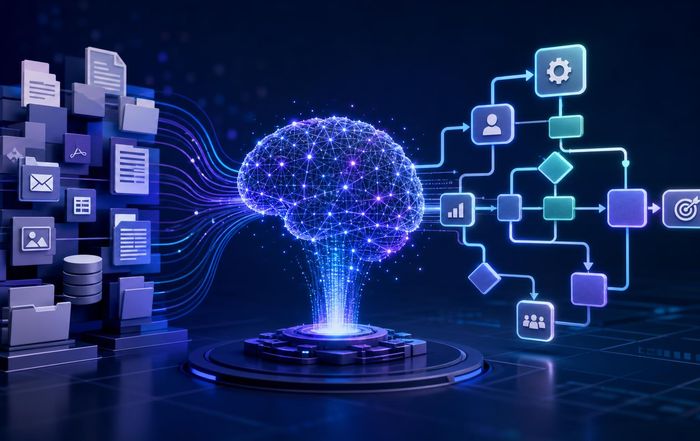
How Generative AI Is Reshaping Business Process Design
Generative AI has moved from experimental pilots to everyday tools inside large and mid-sized organizations. What started as text and image generation is quickly becoming a way to rethink how work itself is structured. Instead of simply automating individual tasks, generative models can help design, simulate, and continuously refine entire business processes in areas such as customer service, finance, HR, supply chain, and product development.
For leaders focused on competitiveness, cost, and growth, the question is no longer whether generative AI will affect process design, but how to harness it without breaking controls, compliance, or trust. This article examines what is actually changing, where value is emerging, and how companies can redesign processes responsibly around generative capabilities.
From task automation to process co-design
Traditional automation-workflow tools, RPA, and classic machine learning-has typically targeted well-defined, repeatable tasks: routing a ticket, extracting a field from an invoice, or predicting churn. Generative AI adds a new layer: it can understand natural language, create structured outputs from unstructured inputs, and propose process variations that humans may not have considered.
Consultancies such as McKinsey and BCG estimate that generative AI could automate or augment a significant share of activities in knowledge-intensive roles, with McKinsey projecting $2.6-$4.4 trillion in annual economic impact across use cases. Crucially, much of this value is expected to come not from standalone tools, but from embedding models into end-to-end workflows such as customer onboarding, loan origination, marketing campaign design, or software development pipelines.
For business leaders, that means process design can no longer assume static decision rules and fixed hand-offs. Instead, processes can be conceived as dynamic systems where generative agents interpret context, draft options, and escalate edge cases, while humans focus on judgment, oversight, and exceptions. This shift is already visible in early deployments in banking, insurance, and professional services, sectors that BizFactsDaily covers frequently across banking, investment, and business topics.
What generative AI actually changes inside a process
The most profound changes are less about "magic chatbots" and more about specific process capabilities that generative AI enables. Several stand out.
First, generative models can transform unstructured information-emails, PDFs, call transcripts, contracts-into structured data and summaries that flow through a process. For example, a claims process in insurance can start with a free-form customer description, which a model converts into a standardized incident report, suggests missing information, and pre-populates downstream systems. Tools like Microsoft's Azure OpenAI Service and Google Cloud's Vertex AI now expose this kind of document and conversation intelligence for enterprise workflows, and their documentation shows how they are being wired into CRM, ERP, and case management systems.
Second, generative AI can act as a "copilot" at decision points. In a loan underwriting process, a model can summarize applicant history, highlight risk indicators, generate a rationale aligned to policy, and propose a decision for human approval. In complex B2B sales, a model can draft a tailored proposal based on opportunity data, previous deals, and product documentation. Early case studies from Salesforce and HubSpot show AI assistants drafting sales emails and proposals, cutting cycle times while preserving human sign-off at key stages.
Third, generative AI allows processes to adapt in near real time. Instead of static scripts in contact centers, for instance, AI can recommend next-best responses based on live conversation transcripts and updated product or policy information. Gartner has highlighted AI-augmented contact centers as a key trend, with agents supported by dynamic guidance rather than rigid call flows. This flexibility changes how processes are designed: less emphasis on exhaustive rule trees, more on guardrails, escalation criteria, and continuous learning.
Finally, generative models can help design and document the processes themselves. Given logs from existing systems and a corpus of procedures, a model can propose an as-is process map, identify bottlenecks, and draft to-be variants. Some process-mining vendors, such as Celonis and SAP Signavio, are integrating generative capabilities to auto-generate process descriptions and improvement ideas, reducing the manual effort of discovery and documentation.
Use cases across core business functions
The impact of generative AI on process design differs by function, but several patterns are emerging that are relevant across industries and geographies.
In customer operations, chatbots and virtual agents are only the starting point. Generative AI can read customer history, summarize previous interactions, and propose personalized resolutions, while automatically updating CRM records and triggering follow-up tasks. This turns a simple "respond to customer" activity into a richer workflow involving knowledge retrieval, content generation, and back-office updates. Companies like ServiceNow highlight AI-powered workflows where incidents are triaged, categorized, and routed with minimal human input, but with clear escalation paths for complex cases. For readers interested in the broader labor and skills angle, this intersects with themes we cover on employment and workforce transformation.
In finance and risk processes, generative AI is starting to support narrative tasks that were previously manual and time-consuming. Regulatory reports, management commentary on financial performance, and credit memos can be drafted automatically from underlying data, subject to stringent review. The Bank of England, for example, has discussed in speeches how AI could affect risk and compliance functions, emphasizing both productivity potential and model-risk concerns. Process designs in these areas must embed human validation, traceability, and clear segregation of duties.
In marketing and sales, generative tools are already used to create copy, visuals, and campaign variants. The more interesting shift is process-level: campaign management workflows can now generate and test far more variants, with AI optimizing messaging, timing, and channel mix. This increases the importance of feedback loops, experimentation, and data governance within marketing operations. Platforms like Meta and Google Ads promote AI-driven creative and bidding optimization, which in turn pushes marketers to redesign internal processes around continuous testing. Our coverage of marketing trends often intersects with these AI-driven operational shifts.
In product development and IT, generative AI is changing software delivery pipelines. Code assistants such as GitHub Copilot and Amazon CodeWhisperer enable developers to generate code, tests, and documentation from natural-language prompts. Studies reported by GitHub suggest productivity gains for developers using AI pair-programming, which affects how teams plan sprints, define acceptance criteria, and conduct reviews. Process designs are shifting toward more emphasis on code review and security scanning, and less on manual boilerplate coding.
Designing processes around AI-human collaboration
As generative AI becomes embedded, the central design question is where to place humans versus machines in a workflow. The answer depends on risk, regulation, and customer expectations, but several design patterns are emerging.
One common pattern is "AI drafts, human decides." In this model, the AI generates content or a decision recommendation, and a human approves, edits, or rejects it. This is increasingly common in legal drafting, marketing content, and customer communications. For example, a bank may use AI to draft responses to customer complaints, but require human review for any communication involving regulatory rights or financial commitments. Process maps in this pattern must explicitly show review steps, thresholds for mandatory escalation, and audit trails capturing what the AI proposed and what the human changed.
Another pattern is "human asks, AI assists." Here, humans remain the primary actors, but AI is embedded as an on-demand advisor. A customer-service agent might ask a copilot to summarize a case, propose a next step, or surface relevant knowledge-base entries. The process design focuses on empowering front-line staff with tools rather than automating them away. This aligns with findings from the MIT Sloan Management Review, which argues in a recent analysis that high-performing organizations treat AI as a collaborator, not a replacement, and redesign roles accordingly.
A third pattern is "AI acts with human oversight." In lower-risk contexts-such as internal IT tickets, low-value refunds, or routine procurement-AI may be allowed to execute actions autonomously within pre-defined limits. Humans monitor performance via dashboards and intervene when metrics drift. This requires robust monitoring, logging, and anomaly detection in the process design, as well as clear rules on when automatic actions are allowed. For global organizations working across jurisdictions, this also means aligning designs with local regulatory expectations, a theme we frequently explore in global and news coverage.
Across these patterns, the key is to design for clarity: who is accountable for each outcome, what the AI is allowed to do, how users can override it, and how errors are detected and corrected. Without this, organizations risk both operational failures and employee resistance.
Governance, controls, and regulatory expectations
Embedding generative AI into processes raises governance questions that go beyond traditional IT projects. Regulators in major markets are moving quickly, and process designers must anticipate compliance requirements.
In the European Union, the EU AI Act-expected to be fully applicable over the coming years-introduces risk-based obligations for AI systems, with stricter requirements for high-risk use cases such as credit scoring, employment decisions, and critical infrastructure. The text, available via the European Commission's AI regulation portal, emphasizes transparency, human oversight, and quality management systems. Business processes in affected areas will need documented risk assessments, clear human-in-the-loop checkpoints, and mechanisms to explain AI-influenced decisions to customers and regulators.
In the United States, the regulatory picture is more fragmented but accelerating. The White House Executive Order on AI and guidance from agencies such as the FTC and CFPB stress fairness, non-discrimination, and truthfulness in AI-driven decisions and marketing. The FTC has issued guidance on using AI truthfully and fairly, warning against over-reliance on opaque models. For processes in lending, hiring, or insurance underwriting, this means designing explainability and documentation into the workflow, not as an afterthought.
Financial regulators such as the Basel Committee on Banking Supervision and ESMA are also exploring model-risk management expectations for AI. While generative models are newer than traditional credit or market-risk models, many banks are extending their model risk management frameworks to cover them, with enhanced validation, monitoring, and change-control processes. This affects how processes are documented, who can modify AI prompts or parameters, and how incidents are handled when AI outputs are found to be erroneous or biased. Readers following our economy and banking coverage will recognize this as part of a broader trend of prudential regulators grappling with digital transformation.
Beyond formal regulation, there are reputational and contractual obligations. Enterprises must consider how generative AI affects data privacy (especially when using third-party APIs), intellectual-property rights for generated content, and commitments made in SLAs with customers. Legal and compliance teams therefore need to be involved early in process-redesign initiatives, helping define where AI can be used, which data it can access, and what disclosures are required.
Data, integration, and the plumbing behind AI-native processes
The promise of AI-enhanced processes often collides with the reality of fragmented systems and messy data. Generative models are powerful pattern recognizers, but they are only as useful as the data and tools they can access within an enterprise.
One design choice is whether to use general-purpose foundation models via API or to deploy domain-specific models fine-tuned on proprietary data. Vendors like OpenAI, Anthropic, and Cohere offer APIs that can be integrated with existing applications, while cloud providers such as AWS, Microsoft Azure, and Google Cloud provide managed services that allow enterprises to host or customize models. The right approach depends on data-sensitivity, latency, and control requirements. For regulated industries, hosting models within a virtual private cloud or on-premises often simplifies compliance, but increases operational complexity.
A second consideration is retrieval-augmented generation (RAG), a pattern where the model retrieves relevant documents or records from enterprise systems at query time and uses them to generate an answer. This allows processes to tap into up-to-date internal knowledge without retraining the model itself. However, it requires robust indexing, access control, and data-quality management. Industry discussions, such as NVIDIA's technical overview of RAG for enterprise search, highlight how much of the effort lies in the retrieval pipeline rather than the model alone.
Integration with existing workflow tools, CRMs, ERPs, and ticketing systems is equally important. Without tight integration, AI remains a side tool rather than a core part of the process. Modern process-automation platforms increasingly expose APIs and connectors to embed generative steps directly into workflows, from drafting emails to summarizing case histories. Organizations that have invested in process mining and orchestration are often better positioned, as they already have visibility into how work flows across systems-a recurring theme in our coverage of technology and innovation.
Measuring impact and avoiding "AI theater"
Many organizations have launched generative AI pilots, but fewer have demonstrated sustained business impact. To move beyond experimentation, process-redesign efforts must be grounded in clear metrics and realistic expectations.
Traditional process metrics-cycle time, throughput, cost per transaction, error rates-remain relevant. Generative AI initiatives should start with a baseline and define target improvements. For example, a customer-support process might aim to reduce average handle time by 20%, increase first-contact resolution, or improve customer-satisfaction scores. Where AI generates content, quality metrics such as compliance with brand voice, factual accuracy, and regulatory adherence must also be tracked. Independent evaluations, like those by Stanford's Center for Research on Foundation Models on LLM behavior and reliability, underscore that models can hallucinate or misinterpret context, so monitoring is not optional.
There is also a risk of "AI theater," where organizations deploy chatbots or copilots that look impressive but do little to change underlying processes or economics. This often happens when AI is layered on top of broken workflows rather than used as a catalyst to simplify and redesign them. A more effective approach is to start with a specific business objective-reducing manual back-office rework, accelerating contract turnaround, or improving fraud-detection throughput-and then ask how generative AI can enable a different way of working. Sometimes the answer involves eliminating steps altogether rather than automating them.
Change management is another critical factor. Employees may resist AI-driven changes if they fear job loss or if tools are poorly integrated into daily work. Transparent communication about roles, upskilling, and guardrails can help, as can involving front-line staff in the design and testing of new workflows. Research from the World Economic Forum on AI and the future of jobs suggests that organizations investing in reskilling and job redesign are more likely to realize productivity gains without severe disruption, a theme that connects with our broader coverage of employment and future-of-work dynamics.
Practical steps for leaders redesigning processes with generative AI
For executives and process owners considering how to embed generative AI, a structured approach can reduce risk and increase the odds of meaningful impact.
A useful starting point is to map processes by both business value and "generativity" potential. High-value processes that rely heavily on unstructured information, repetitive drafting, or complex decision support are prime candidates. Examples include customer onboarding, KYC reviews, marketing campaign creation, procurement contract review, and internal knowledge-management workflows. Process-mining tools and operational data can help identify where delays, rework, or manual hand-offs are most pronounced.
Next, organizations can run targeted pilots with clear success criteria and strong cross-functional teams. Involving business owners, IT, data science, legal, and compliance from the outset helps ensure that pilots are technically feasible, compliant, and aligned with user needs. Many firms adopt a "two-speed" approach: a fast lane for low-risk experimentation and a governed lane for scaling successful patterns into core processes.
Governance frameworks should be established early, even if they are initially lightweight. These typically cover model selection and approval, data-usage policies, prompt-engineering standards, human-in-the-loop requirements, incident-response procedures, and vendor-risk management. Industry groups such as the NIST AI Risk Management Framework in the U.S., available via NIST's official site, offer reference structures that can be adapted to enterprise contexts.
Finally, organizations should plan for continuous iteration. Generative AI capabilities, costs, and risks are evolving rapidly, and so should process designs. Feedback loops from users, customers, and monitoring systems can inform prompt adjustments, model updates, and even fundamental process changes. Rather than treating AI-enabled processes as static, leading firms are moving toward "living" process architectures that can evolve as models and regulations change.
Where this leaves business process design
Generative AI does not make process design obsolete; it makes it more important and more strategic. The ability to generate text, code, and structured outputs from natural language enables new ways of orchestrating work, but it also introduces new forms of risk and complexity. Organizations that simply bolt AI onto existing workflows are likely to see limited returns and heightened risk. Those that treat generative capabilities as a design material-rethinking roles, controls, data flows, and customer interactions-stand to reshape their operating models.
For executives, operations leaders, and founders, the challenge now is to move from experimentation to disciplined redesign: choosing the right processes, defining AI-human collaboration patterns, embedding governance, and investing in the data and integration "plumbing" that makes AI reliable at scale. As generative tools continue to mature, the competitive gap will increasingly reflect not who has access to models, but who has redesigned their processes to use them wisely.
