
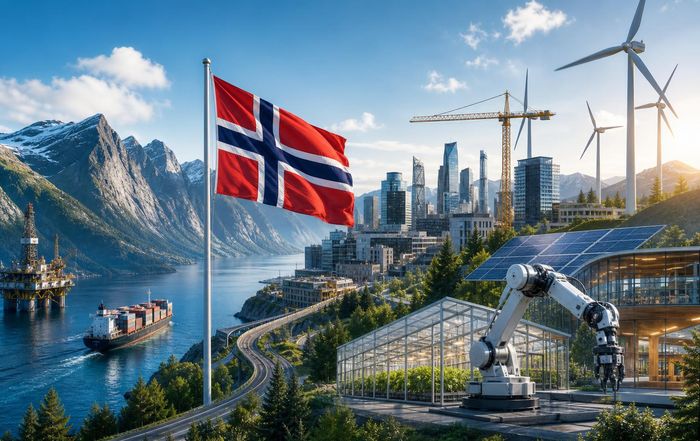
Norway's Business Growth Outlook Beyond Energy
Norway is often reduced to a shorthand: oil, gas, and sovereign wealth. Yet beneath the surface of the energy sector, a quieter restructuring of the Norwegian economy is under way. As the world accelerates its climate transition and fossil fuel demand faces long-term uncertainty, Norway is trying to pivot from being a hydrocarbons superpower to a diversified, innovation-driven economy.
This shift matters well beyond Scandinavia. Norway's experiment offers a real-time test case in how a high-income, resource-rich country can use its financial buffer, human capital, and institutions to rewire growth engines without destabilizing jobs, public finances, or competitiveness.
Why Norway Needs Growth Beyond Oil and Gas
Oil and gas still loom large. According to Statistics Norway (SSB), petroleum and related services have historically accounted for around a fifth of Norway's GDP and a much larger share of exports. In 2022-23, elevated gas prices after Russia's invasion of Ukraine pushed export earnings to record levels, reinforcing how exposed the country remains to energy markets.
At the same time, the long-term direction of travel is clear. The International Energy Agency (IEA) has repeatedly stressed in its World Energy Outlook that global fossil fuel demand is expected to plateau and then decline under most plausible climate and policy scenarios. The European Union, Norway's biggest energy customer, has enshrined its climate neutrality by 2050 target, implying structurally lower demand for hydrocarbons over time.
Norway's own government acknowledges this. The Ministry of Finance and Norges Bank have both highlighted in official documents that petroleum revenues will diminish as fields mature and global demand shifts. The fiscal rule that caps the structural use of oil revenues at 3 percent of the Government Pension Fund Global (GPFG) per year is designed precisely because oil income is temporary. Long-term welfare therefore depends on productivity and value creation in the mainland (non-oil) economy.
This creates both a challenge and an opportunity: how to redeploy capital, engineering talent, and institutional strength from oil and gas into new, globally competitive sectors without triggering a hard landing in employment or living standards.
For smart people focused on bigger economic dynamics, this diversification question sits squarely at the intersection of business, economy, innovation, and investment that we routinely track.
The Macroeconomic Backdrop: Stability with Structural Shifts
Norway starts from a position most countries would envy. It has one of the world's largest sovereign wealth funds, worth over US$1.6 trillion according to Norges Bank Investment Management, and consistently ranks near the top in UN Human Development Index and World Bank measures of income per capita. Unemployment remains low by European standards, and public finances are strong.
Yet beneath this apparent stability, the structure of growth is changing. Mainland GDP (excluding oil and gas extraction and pipeline transport) has become the main driver of employment and wage growth. The OECD's latest Economic Survey of Norway highlights that productivity growth outside petroleum has been modest over the past decade, raising concerns about long-term competitiveness as labor costs remain high.
That tension - high wages and strong welfare expectations versus the need to compete globally in new industries - shapes much of Norway's diversification debate. It also explains why policymakers emphasize innovation, digitalization, and advanced manufacturing rather than labor-intensive, low-margin activities.
For international investors and corporate strategists, this means Norway is not seeking to be a low-cost hub; it wants to be a high-value, knowledge-intensive one.
Emerging Growth Engines: From Oceans to Algorithms
Norway's non-energy growth story is not a single narrative but a mosaic of sectoral bets. Several areas stand out as priorities where the country has natural strengths, policy support, or both.
Ocean industries: Aquaculture, maritime tech, and offshore know-how
Norway's geography and maritime heritage give it a structural advantage in ocean-based industries. It is already one of the world's largest exporters of farmed salmon, and seafood is a major contributor to non-oil exports. The government's Ocean Strategy emphasizes sustainable growth in fisheries, aquaculture, and marine biotechnology.
The sector is increasingly tech-driven. Companies and research institutions are investing in:
Digital monitoring and AI-based health management for fish farms
Offshore and closed-containment aquaculture technologies
Advanced vessel design, automation, and low-emission shipping solutions
This builds directly on Norway's offshore engineering expertise developed in oil and gas. Many of the same companies and clusters that once focused on petroleum now design subsea equipment, autonomous ships, and complex marine operations - a classic example of capability redeployment rather than starting from scratch.
For readers interested in how sectoral shifts shape global trade and sustainable business models, Norway's ocean industries illustrate how environmental constraints can spur innovation rather than simply restrict activity.
Renewable energy and clean tech: From hydro to offshore wind and batteries
Norway already generates almost all its domestic electricity from hydropower, giving it one of the lowest-carbon power systems in the world. The next growth phase is about exporting clean energy and technology rather than just raw hydropower.
The government has launched auctions for offshore wind areas, and the Norwegian Energy Commission has argued that large-scale offshore wind is needed to meet future power demand and support new industrial projects. The North Sea is being reframed as a "green industrial ocean," where offshore wind, carbon capture and storage (CCS), and hydrogen can be layered on top of existing offshore infrastructure.
Several projects illustrate this:
Longship, Norway's full-scale CCS project, supported by the government, aims to demonstrate the viability of capturing CO₂ from industrial sources and storing it under the seabed. The transport and storage component, Northern Lights, is a joint venture between Equinor, Shell, and TotalEnergies, presenting Norway as a potential CO₂ storage hub for European industry. Details are available via Norwegian Ministry of Petroleum and Energy.
Multiple battery cell and materials projects, such as Morrow Batteries and FREYR Battery, are attempting to build a Nordic battery value chain, though some have faced delays and capital-market challenges. This reflects both the opportunity and execution risk in scaling capital-intensive green industry in a small market.
Hydrogen and ammonia projects are being explored for maritime fuel and industrial use, with Norway leveraging its gas infrastructure and maritime cluster.
These initiatives align with global trends tracked on our technology and stock markets coverage, where green industrial companies are increasingly central to both infrastructure and equity narratives.
Digital, AI, and advanced services: A quiet but important shift
Norway does not have a consumer tech giant on the scale of a U.S. or Chinese platform, but it has a growing digital and software ecosystem, supported by high broadband penetration, strong universities, and a digitally literate population.
The government has set out national strategies for artificial intelligence and digitalization, emphasizing public-private collaboration, data sharing, and ethical frameworks. Oslo and Trondheim host clusters of startups and scale-ups in:
Industrial software and digital twins for energy, maritime, and manufacturing
Fintech and digital banking solutions
Health tech, including telemedicine and digital health records
AI-driven analytics for logistics, mobility, and environmental monitoring
Norway's banks and financial institutions are particularly advanced in digital services. BankID, a national electronic identification system used for banking and public services, has become a backbone of digital commerce. The Nordic region more broadly is a leader in digital payments and online banking, trends we frequently explore in our banking and artificial intelligence sections.
For international technology firms, Norway's market size is modest, but it offers a sophisticated testbed for digital solutions in sectors like energy, maritime, and health that can then be scaled globally.
Tourism, creative industries, and niche manufacturing
Tourism has been a growing contributor to regional employment, especially in the fjord and northern regions, supported by Norway's strong international brand as a nature destination. However, the pandemic exposed vulnerability to global travel shocks, and there is an ongoing debate about overtourism in fragile environments. The government and local authorities are increasingly focused on sustainable tourism models that balance income with environmental and social impacts.
Creative industries - gaming, design, music, and film - have also expanded, helped by digital distribution and targeted support measures. Norwegian game studios and streaming-era musicians have found global audiences, demonstrating that high-cost locations can still compete in IP-driven sectors.
On the industrial side, Norway retains niche strengths in advanced manufacturing, including aluminum, chemicals, and specialized equipment. These sectors are increasingly pressured to decarbonize, but that challenge can become a competitive advantage if Norwegian producers can market low-carbon materials to global buyers facing Scope 3 emissions scrutiny.
The Role of the Sovereign Wealth Fund in Diversification
The Government Pension Fund Global (GPFG), often simply called the oil fund, is the financial anchor of Norway's diversification strategy. Managed by Norges Bank Investment Management (NBIM), it invests oil and gas revenues in a globally diversified portfolio of equities, bonds, and real estate, with ethical guidelines and long-term return targets.
Crucially, the fund is invested almost entirely abroad. This is deliberate: it prevents overheating the domestic economy and spreading "Dutch disease," where a resource boom crowds out other sectors via an overvalued currency and wage pressures. The fiscal rule then allows only a small, stable share of the fund's value to be spent each year, smoothing volatile oil revenues into predictable budget support.
This architecture supports diversification in several ways:
It shields the mainland economy from oil price swings, allowing businesses outside energy to plan and invest with less macro uncertainty.
It finances public investment in infrastructure, education, and research, which underpin productivity growth.
It helps maintain social cohesion by funding welfare without excessive taxation, making structural change more politically sustainable.
However, the GPFG is not a direct industrial policy tool. Unlike some sovereign funds that take active stakes in domestic strategic sectors, Norway's fund is largely passive and foreign-oriented. Domestic diversification relies more on tax policy, regulation, infrastructure, and targeted innovation programs than on direct sovereign equity injections.
For global investors, this means Norway's diversification does not create the same kind of state-capital overlaps seen in some other resource economies. Instead, the fund is a major player in international capital markets, influencing corporate governance and sustainability standards worldwide. NBIM's responsible investment reports detail its engagement on climate risk, human rights, and corporate governance - factors increasingly relevant to ESG-focused portfolios.
Policy Tools: How Norway Is Trying to Rewire Growth
Norway's policy mix for moving beyond oil is multifaceted rather than built around a single flagship plan. Key levers include:
Taxation and incentives: The petroleum tax regime has been adjusted over time to balance continued investment with fiscal returns. At the same time, incentives for renewable energy, R&D, and green industrial projects have been expanded, though debates continue over how generous they should be.
Innovation funding: Agencies like Innovation Norway and the Research Council of Norway provide grants, loans, and advisory services to startups, SMEs, and research collaborations. Their focus increasingly includes digitalization, green transition, and export-oriented innovation.
Education and skills: Norway invests heavily in education, with free higher education and strong vocational training. Universities such as NTNU in Trondheim are central to engineering and tech talent pipelines. The challenge is aligning curricula and lifelong learning programs with emerging industries, especially as some petroleum-related jobs decline.
Regulation and standards: Norway often adopts or shapes advanced environmental and safety regulations, from offshore standards to building codes. While this can raise costs, it also pushes firms to innovate and can create exportable expertise in compliance and technology.
Infrastructure: Continued investment in transport, digital infrastructure, and power grids is critical to supporting regional development and new industrial projects, especially in areas suited for wind, hydrogen, or data centers.
These measures are not unique globally, but Norway's combination of fiscal space, institutional capacity, and social trust gives them a better chance of being executed coherently than in many countries.
Readers tracking broader news on the green transition will recognize similar policy tools in the EU's Green Deal, the U.S. Inflation Reduction Act, and strategies in countries like Canada and Australia; Norway's version is distinctive in how it leans on ocean industries and offshore competence.
Constraints and Risks: High Costs, Slow Permits, and Political Trade-offs
Norway's diversification effort is not without friction. Several structural constraints shape the outlook:
First, the cost level is high. Generous wages, strong unions, and extensive worker protections underpin social stability but make it hard to compete in low-margin manufacturing or services. That reinforces the need to focus on high-productivity, knowledge-intensive sectors - but not all regions or workers can transition easily into those roles.
Second, permitting and regulatory processes can be slow and complex, particularly for large renewable projects like onshore wind, new transmission lines, or industrial plants. Local opposition over land use, reindeer herding, and environmental impacts has delayed or blocked developments, as seen in high-profile cases such as the Fosen wind farm dispute, where the Norwegian Supreme Court ruled that wind turbines violated Sámi reindeer herding rights. Balancing indigenous rights, biodiversity, and industrial expansion is a persistent challenge.
Third, there is political tension between continuing to invest in oil and gas - which still generates jobs and revenue - and accelerating the green shift. Governments have faced criticism both from climate activists who argue Norway's exploration policies are inconsistent with the Paris Agreement, and from industry and unions who fear a too-rapid phase-down would undermine economic security. The result has been a gradualist approach: continued petroleum activity, particularly gas for Europe, alongside ramped-up investment in renewables and CCS.
Fourth, global competition is intensifying. The EU, U.S., China, and others are all pouring money into batteries, hydrogen, and clean tech. Norway's domestic market is small, and its support schemes must comply with European Economic Area (EEA) rules on state aid, limiting how aggressively it can subsidize domestic champions relative to some larger economies.
For investors and multinational companies, these constraints mean Norway is an attractive but not frictionless environment. Projects can benefit from political stability and strong rule of law, but they must navigate local concerns, environmental scrutiny, and intricate permitting.
Opportunities for Investors and Businesses
Despite these headwinds, Norway offers several compelling opportunities for businesses and investors looking beyond hydrocarbons:
Participation in the green industrial build-out: Offshore wind, CCS, hydrogen, and battery projects require global capital, technology, and offtake agreements. International firms with relevant expertise can find Norwegian partners eager to collaborate.
Digital and AI applications in traditional sectors: Norway's strengths in energy, maritime, and aquaculture create demand for specialized digital solutions - from predictive maintenance and optimization algorithms to AI-enabled environmental monitoring. This aligns closely with the kinds of cross-sector AI applications we analyze in our new artificial intelligence and technology content.
Fintech and digital banking: With high digital adoption and sophisticated incumbents, Norway is a strong test market for new financial technologies, including open banking applications, regtech, and advanced risk analytics.
Low-carbon materials and industrial inputs: Producers of equipment, software, and services that help Norwegian industry cut emissions can tap into a policy-driven demand wave as companies respond to EU climate policies and investor pressure.
Tourism and experience economy: While more exposed to cyclical and environmental constraints, high-end, sustainable tourism concepts can leverage Norway's natural assets and strong international brand.
For global corporates and investors, the key is to view Norway not only as an energy exporter but as a specialized innovation partner in ocean, climate, and digital solutions.
How Norway's Transition Fits into the Global Economic Story
Norway's efforts to grow beyond energy are part of a broader pattern: resource-rich economies trying to pivot before global demand for their primary exports tapers off. Countries from the Gulf states to Canada and Australia are pursuing similar strategies, with varying degrees of urgency and success.
Norway's distinguishing features are its early start, robust institutions, and disciplined use of resource revenues. Its success or failure will therefore be watched closely by policymakers and investors looking for models of "orderly transition" that avoid both economic stagnation and social backlash.
For international businesses, Norway's trajectory underscores several wider themes we watch across business, investment, and global coverage:
The green transition is not just an environmental agenda but an industrial one, reshaping where and how value is created.
Sovereign wealth funds and public investment rules are becoming central to how countries manage structural change.
High-income economies must find ways to maintain generous welfare states while competing in knowledge-intensive global markets.
Norway is unlikely to become unrecognizable: oil and gas will remain important for years, and the GPFG will continue to be its most visible economic symbol. But the direction of travel is clear. The country's long-term growth story will be written increasingly in the language of offshore wind, CCS, aquaculture technology, digital services, and advanced manufacturing - not just in barrels and cubic meters.
For businesses and investors willing to engage with this evolving landscape, Norway offers a laboratory for the next phase of the global economy: one where energy wealth is a starting point, not a destiny.
